Your Company Already Has a Brain. It Just Can't Talk Yet.
By Stuart Hall · AI for Owners · Issue 3
- How to get answers from information already inside your business
- How to spot customer risks and operational problems before they become expensive
- How to start with one high-value question instead of rebuilding your entire tech stack
In the Avengers movies, Tony Stark built a superintelligence named Jarvis. He talks to Jarvis like a teammate, using it to analyze problems and decide what to do next.
That scenario is no longer the realm of comic book heroes. Imagine walking into your office and asking your company brain: “Why did sales fall last month?” and moments later, your company brain gives you an answer, shows you the evidence, and points to what needs your attention.

What Would It Mean to Give Your Company a Brain?
It is a big shift: being able to question the business itself and get an answer from information it already holds.
A company brain is not a “better chatbot.” It is AI with controlled access to the information your company already produces.
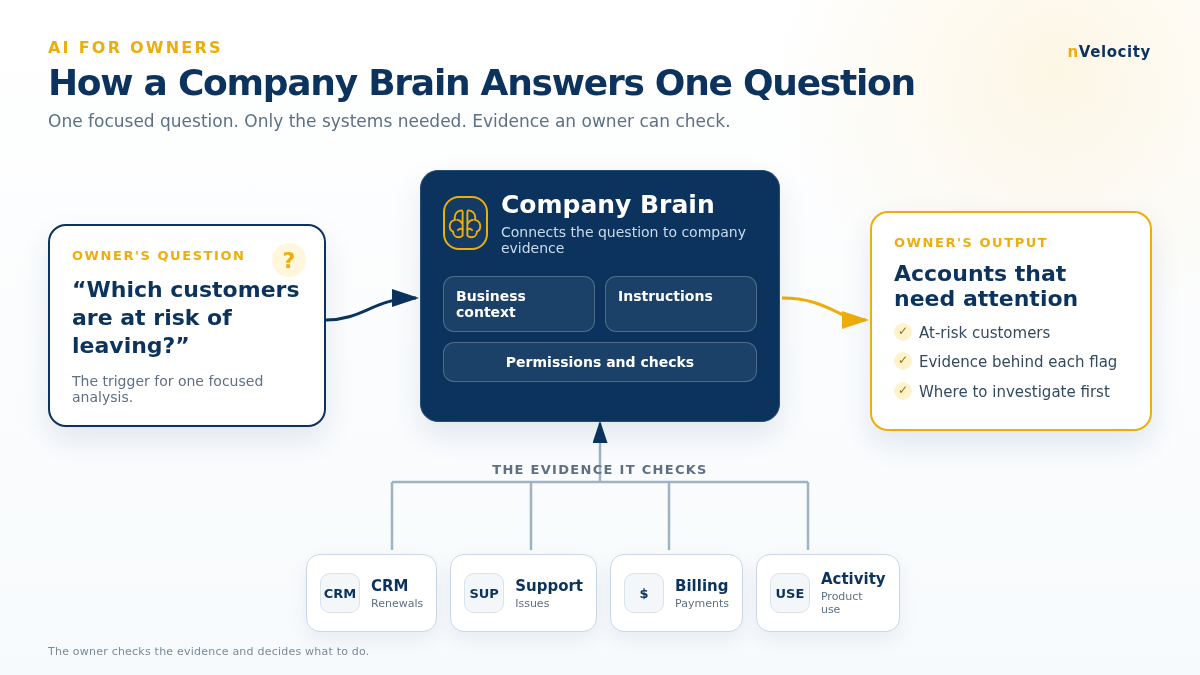
A company brain combines two things: what your business knows and instructions for how the AI should work with that knowledge. The information comes from connected systems. The AI reads across those sources, follows the rules you set, and produces an answer based on the business as a whole.
You can also define its role. It might work as an operations advisor, sales analyst, financial reviewer, or a direct executive sounding board.
The raw material for your company brain is already there, but it is locked across files, apps, and platforms that barely talk to each other.
That is why answering a basic management question can mean opening several reports, checking a spreadsheet, and asking department heads for their version of events.
A company brain connects the relevant information so you can question the business as a whole.
AI Is a Pattern-Matching Machine. Feed It Your Data
An AI is an extraordinarily powerful pattern-matching machine. It excels at finding signal in noise: connections buried across your data that no human would reasonably have the time or bandwidth to notice.
The Key Word Is “Built”
You won't get Jarvis-like results by opening a browser tab and typing into ChatGPT. A general-purpose AI has no idea who your customers are, what your margins look like, or why your best sales rep just went quiet. It's powerful but it's blind to your business.
The results come when you build the brain: connect your data sources, organize your company knowledge, and give the AI the context it needs to work with your specific situation.
This is exactly the kind of work that used to require a big contract from a consulting company.
Company-Wide Analysis Is No Longer Enterprise-Only
Hire a top-tier consulting firm and a strategy engagement can cost seven figures and run for two or three months. The work may be excellent. But it's expensive, it's slow, and then it's over.
A company brain works differently. It's not a one-time engagement, it's an always-on resource. Ask it a question at 11pm on a Tuesday and it answers. Ask it the same question in three months with updated data and it gives you a fresh read. It evolves as your business does.
Start With One Question
Do not start by connecting every system in the company.
Write down one question you ask repeatedly but cannot answer without opening several reports, messaging employees, or assembling another spreadsheet.
For example:
- Why did sales fall this month?
- Which customers are at risk of leaving?
- Where are jobs getting delayed?
- Which marketing activity produces profitable customers?
That question defines the first version of your company brain. Connect only the information needed to answer it. Compare the AI's response with what your team already knows. Check its evidence. Correct what it gets wrong.
Expand the system only after its answers earn your trust.
This is not free to build, but it is now within reach of smaller businesses that could never justify a seven-figure consulting engagement.
Want help choosing the first question your company brain should answer? Message me “brain.”
Sources
How much do McKinsey, BCG and Bain charge clients for a consulting case?, RocketBlocks · How Much Does a McKinsey Consulting Project Actually Cost?, Case Interview Hub
I share tools like this regularly. If this one was useful, follow along.
What's the one question you'd want your company brain to answer first? Drop it in the comments.
Know a business owner who should be reading this?
Forward this email or share your referral link below.