Welcome to AI for Owners — a newsletter on how business owners are actually using AI, what the data says, and practical tools you can put to work. No hype, no textbook theory. If someone forwarded this to you, you can subscribe below.
The AI Adoption Curve
There has been a lot of AI hype. This is typical of the early part of any past technology adoption curve.
That's why this study published by OpenAI with researchers from Columbia, Duke, and the University of Pennsylvania stood out in my feed. Let me break it down and give you my take.
The study tracked real usage data across two products:
- ChatGPT — a chat interface where you ask questions and get answers
- Codex — where you hand off a task and the AI executes it (writing code, handling files, managing calendars, filling out forms)
Going from ChatGPT to Codex is going from "answer my question" to "do this task for me." This is a shift from research to action.
The study shows who is making that transition, and how fast.
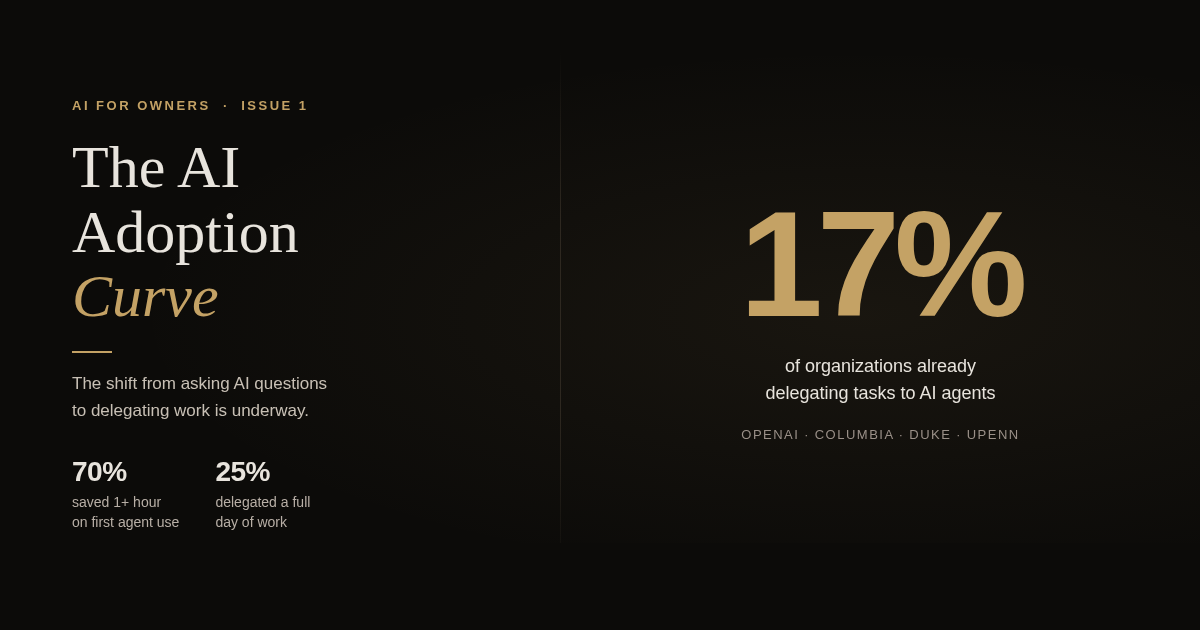
In August 2025, organizations had close to zero Codex usage relative to their ChatGPT usage. AI was "just a chatbot." The share of Codex (do things for me) vs ChatGPT (answer my questions) has jumped to 17% today.
Among individual users who tried agents even once, 70% made at least one request that saved more than an hour of human work. Twenty-five percent delegated tasks that would have taken a full day or more.
Non-developers are now the fastest-growing user group. The Axios reporter who covered the study described delegating her expense reports, email triage, and scheduling. No coding background.
These are not projections. While the data is limited to OpenAI, it shows a trend we've seen before. The technology adoption curve is ramping up.
This is not a story about a wave that already hit. It is a story about one that is building.
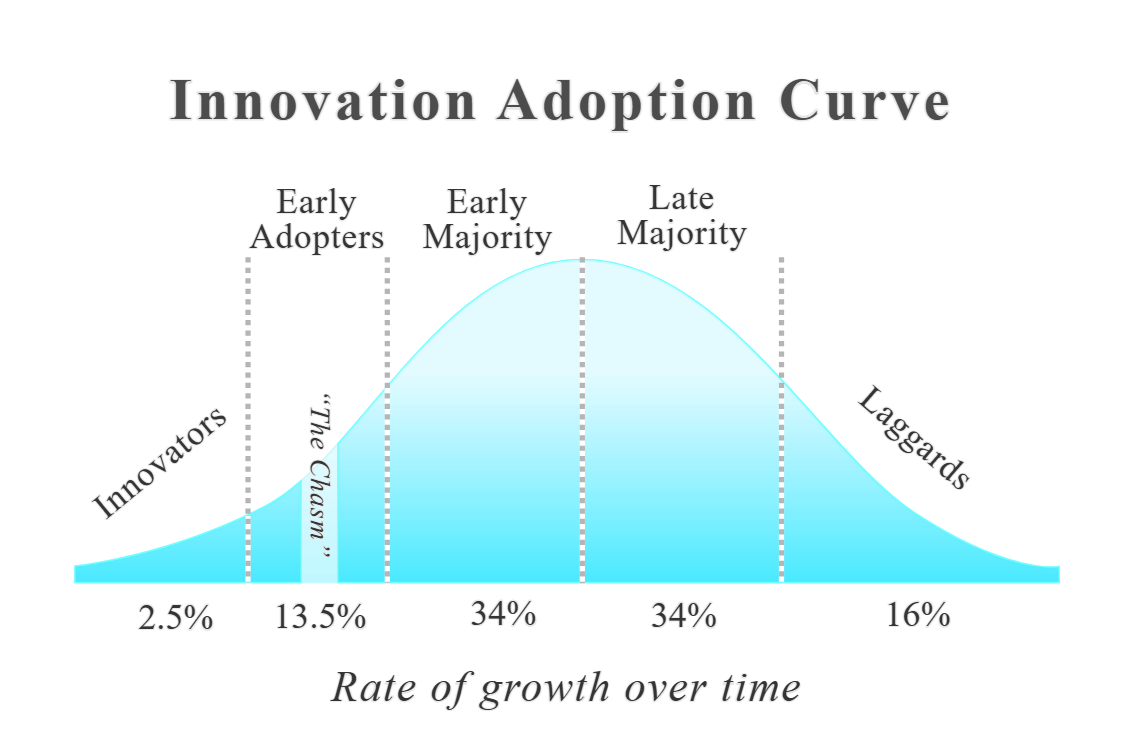
The OpenAI data places the market in "The Chasm" of Early Adopters
The 17% organizational adoption figure is important because organizations move fast once early adopters demonstrate results internally.
Technology adoption has followed the same curve for decades. Early adopters move first. A chasm opens between them and the mainstream. Then something shifts and the curve steepens. What looked like a niche becomes standard faster than most businesses expected.
The data says we are sitting at the bottom of that steep climb right now. Early adopters have crossed to agents and are delivering results their organizations can see. That is exactly how every major technology transition has started.
What is different this time is the speed. Previous cycles took years, but each tech cycle has been shorter than the last. AI adoption has outpaced every prior cycle on record. The S-curve is steeper and the timeline is compressed.
Businesses can now point to a specific, measurable output. Sales automation that closes more deals. Business intelligence reports created on demand. When a technology can justify itself with a number you can put on a spreadsheet, the pace of adoption quickens.
This is no longer AI for the sake of AI. It is AI because it has a verifiable impact on the business.
Caveat: AI is far from a plug-and-play solution. Yet the data shows 17% of organizations already delegating work to AI. Based on every prior technology cycle, the benefits from using AI will be most profound for those who implement early and intentionally.
Why should you care?
You are in one of three places:
Haven't started. Aware of AI, not running any meaningful workflows through it yet. This is the majority position today. The gap between here and the next tier is growing each quarter.
Ramping up. Testing tools, running a few tasks through agents, building confidence in what they can handle. The compounding starts here.
Integrated. AI is running parts of the operation that used to require your time or your team's. Not just saving hours. Creating capacity for the work that requires human judgement and talent.
Adoption does not move gradually and then stay there. It moves slowly and then accelerates.
The business that is integrated today has six months of compounding ahead of them.
The business that is still deciding has a different future. A slow divergence that does not feel urgent until the AI-powered competition builds a noticeable gap.
The data shows the shift from chat to delegation is underway. The question for any business owner is not if they will use AI in their business, but when.
Know a business owner who should be reading this?
Forward this email or share your referral link below.